
Designing for every body shape: Why fit is one of the hardest problems in exoskeleton design

When we do a typical initial fitting of an exoskeleton, one thing becomes obvious very quickly: the same exoskeleton never feels the same on two different people.
Even before anyone starts working, walking, or lifting, differences appear. One person feels immediate support. Another adjusts a strap twice. A third asks whether something is “supposed to feel like this”.
These moments are not exceptions. They are the norm. And they highlight one of the hardest problems in exoskeleton design: the fit.
Fit is a core constraint that influences how an exoskeleton feels, functions, and whether it will be used at all. In development, this means repeated testing, adjustment, and rethinking of how the system sits on real people.
Humans don’t come in “standard sizes”
In mechanical engineering, most components follow predictable dimensions. Parts fit because they’re designed to. Holes align. Forces follow clear paths. Structures behave as expected.
Humans? Completely different story. We come in all shapes: tall, short, narrow shoulders, broad shoulders, long arms, short arms – the list goes on and on.
Two people with the same height can have completely different proportions.Two people with the same weight can have opposite body shapes.
And unlike clothing, exoskeletons don’t just need to sit. They need to transfer load, move smoothly with the body and stay in place during work.
Fit is therefore fundamentally different from sizing. In practice, there is no label that reliably predicts how an exoskeleton will behave on a person. What matters is how the system aligns with a body that moves, shifts and loads differently from movement to movement. That is why fit quickly becomes an engineering problem, not a sizing one.
An exoskeleton isn’t just worn. It needs to work with you
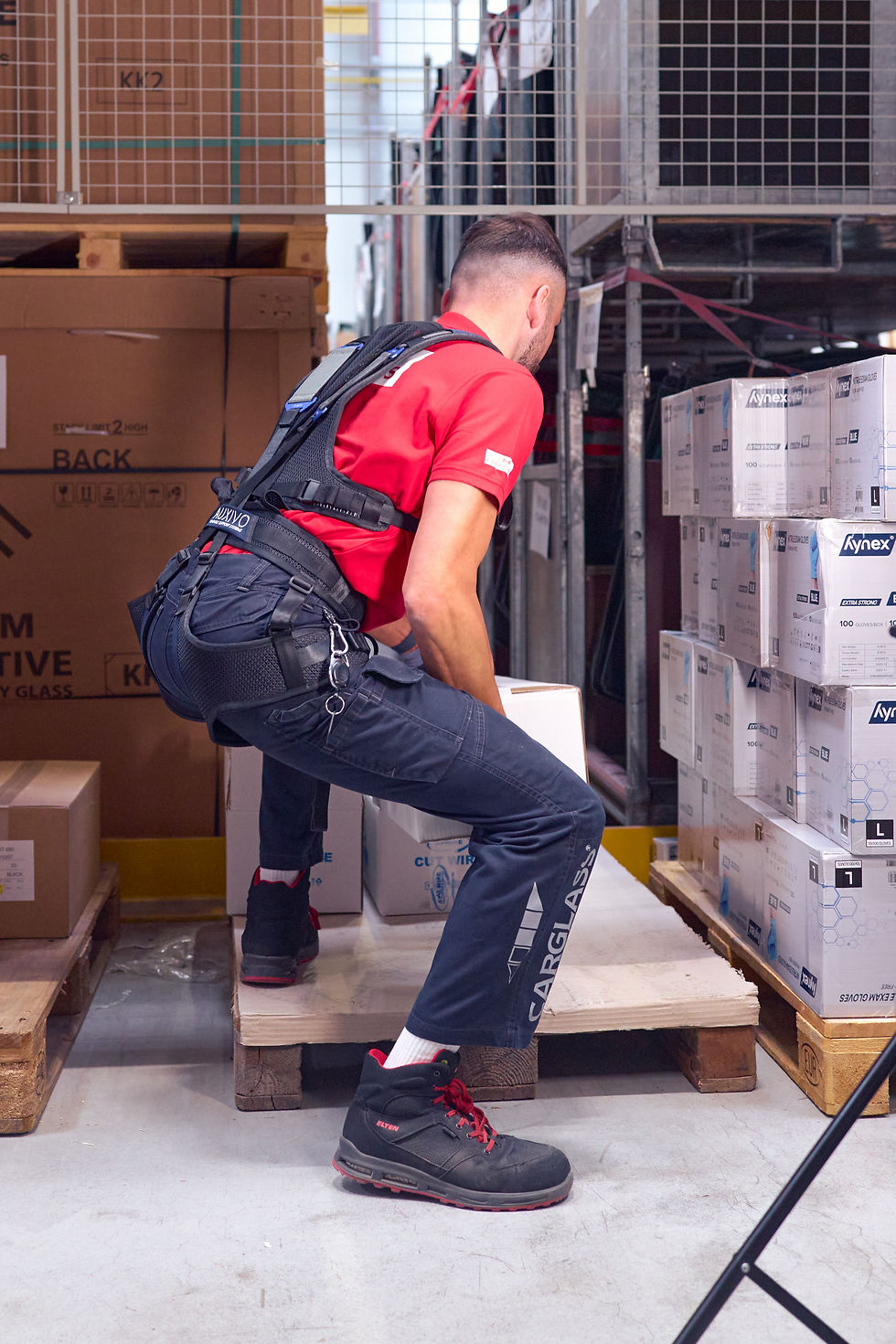
A good fit is not about comfort alone. It directly affects the function of the exoskeleton.
If the fit is off:
Support might not activate properly
Forces may not be transferred where they should
Straps may slip
Pressure points can appear
Movement may feel restricted instead of supported
What looks like a small mismatch can change how loads travel through the system. A few centimeters in joint alignment or strap position can be the difference between helpful support and resistance.
This sensitivity is the reason testing is done with many people across the full range of body shapes found in everyday work environments.
Textile + Mechanics = The real challenge
One of the biggest insights from our team is that fit is a truly interdisciplinary task.
The mechanical structure (if present) needs to resemble the human anatomy sufficiently.
The textile interface needs to be well designed and positioned to transfer and distribute forces reliably but also comfortably.
The adjustment system needs to be intuitive enough for anyone to use without specialist knowledge.
If any of these three are off, the whole system feels wrong.
In practice, this means that fit cannot be solved on paper. It has to be validated on moving bodies. Small changes in how the system is built and adjusted can have a large impact once real motion comes into play.
As a result, development often focuses on small details such as seam positions, strap angles, padding thicknesses, or contour shape. These changes are rarely visible in product photos. But they can be decisive in whether an exoskeleton feels natural or intrusive.
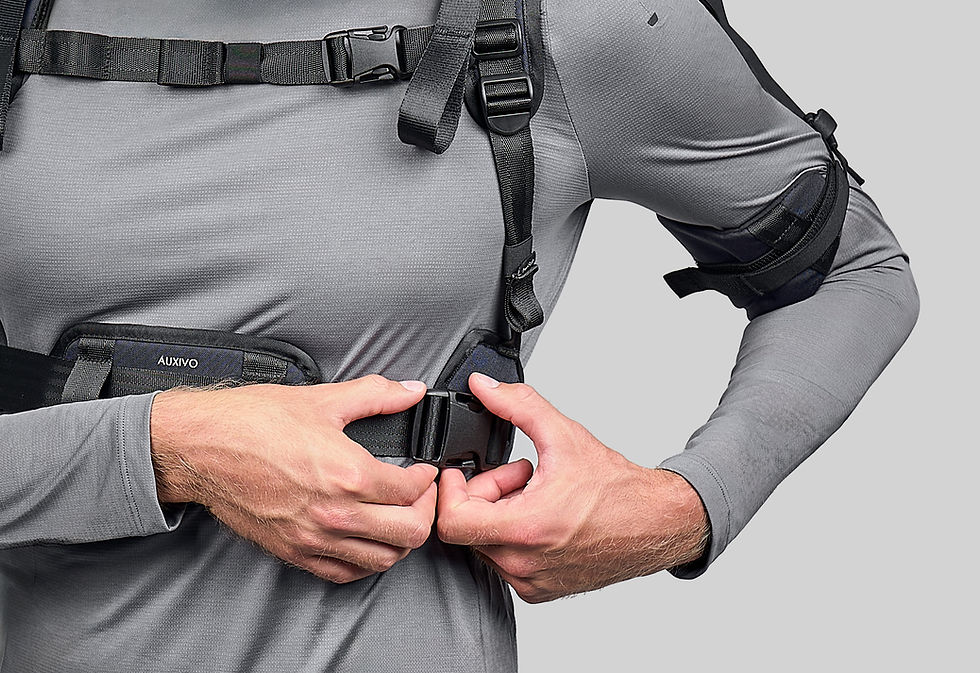
The holy grail: One design, thousands of body shapes
For real-work deployment, exoskeletons cannot be bespoke solutions for individuals. They need to work across teams, shifts, and sites.
That means adjustability. But not so much adjustability that the system becomes complex or frustrating to set up.
The sweet spot sits somewhere between:
Simple adjustment
Broad fit range
Stable load paths
Minimal points of failure
Good user experience
Auxivo exoskeletons rely on flexible textile constructions, self-alignment elements, and adjustment methods that can be set up in seconds. These choices are not about convenience, but about making day-to-day use realistic.
If a worker needs 15 minutes and a manual to get the fit right, acceptance drops immediately.
Learnings from the field

During field tests of new prototypes, we constantly observe how people actually put on and adjust the exoskeletons. And the reality is: everyone does it slightly differently.
Some prefer it tight, others prefer more freedom. Some forget to tighten a strap, others activate the system earlier or later than intended.
These differences aren’t “user errors”. They are signals. They show us where the design needs to be clearer, simpler and more intuitive. And those learnings flow directly into next prototype.
Where we’re heading
In the long term, we expect exoskeletons to adapt even better to body shape and movement:
Advanced textiles
Lighter and more breathable materials
Designs that feel more like clothing than equipment
But even with new materials, the reality remains: Designing for every body shape will always be one of the hardest and most important parts of developing exoskeletons.


