
Teaching Exoskeleton Technology to Medical Students: A Case Study from ETH Zurich
Introduction & Overview
The Medical Engineering I & II course at ETH Zurich is part of the Bachelor in Human Medicine and is taught in the third year (semester 5–6). The course, organized by the Rehabilitation Engineering Lab, introduces medical students to the fundamentals of medical technology through a combination of lectures, guided practical exercises, and a project-based hackathon.

In the last session (2025/2026), a total of 99 students participated. Six to eight teaching assistants supported them. A central element of the course is the use of the EduExo Pro as a hands-on learning platform. In total, 24 units were used in the course, split over 24 groups of 4 to 5 students each. Each group works with their dedicated exoskeleton throughout the course. The setup is designed so that all students actively interact with the system during each lecture.
The course aims to enable medical students and future doctors to:
Prepare for the collaboration with engineers, and understand their approach to the analysis and characterization of technical challenges
Describe the user-centered design and evaluation process of a medical engineering system
Explain the fundamentals of data acquisition, signal processing and controls engineering
Interpret measurements of physiological signals and analyze these for noise contributions
Acquire practical experience with sensors/signals, actuators, signal processing, controls as well as 3D design/printing
Apply the acquired skills in a one-week hackathon (6th semester)
The focus is on application and understanding. With its strong hands-on, project-based learning approach, the course is designed to give medical students a good working understanding of how such systems are built and how design decisions affect usability and performance.
Course Structure and Content
The course is divided into two main parts. Medical Engineering I is a weekly lecture during the Autumn semester offered over 12 weeks, and Medical Engineering II is an intense, one-week hackathon that culminates in a friendly competition on the last day in which the developed solutions are put to the test.
Medical Engineering I (Autumn Semester)
The goal of Medical Engineering I is to teach the theoretical and technical fundamentals, giving students a broad understanding of rehabilitation technology, combined with hands-on experience and practical skills in medical device development. Guest lectures from experienced clinicians and an exoskeleton user with paraplegia add first-hand perspectives, giving students insights into clinical practice and patient needs.
A central element of the course is working hands-on with a wearable exoskeleton. Students use it to explore sensing, signal processing, control, and human–machine interaction in a practical context.
The course outline:
Format: Weekly sessions over 12 weeks
Duration per session: approximately 3 - 4 hours
Structure: Lecture followed by hands-on exercise

The course covers various topics, from basic concepts to system-level understanding:
Introduction to medical engineering and system design
Human factors and biomechanics
Sensing and sensor characteristics, signal acquisition and processing (including filtering and interpretation), deep dive on EMG acquisition and analysis
Actuation principles
Intention detection and control strategies
System evaluation, safety, and usability
Each topic is directly linked to a practical exercise using the EduExo Pro. By the end of the course, students are familiar with the theory, hardware, software, and control systems and have worked with real sensor data and implemented all basic control algorithms to observe system behavior.
Medical Engineering II (Hackathon Week, Spring Semester)
The second part is a one-week block course organized as a hackathon. Students continue to work in groups and extend the EduExo by developing a gripper module. The application scenario is assisting a person with impaired arm and hand function in manipulating everyday objects.

Team members take on specific roles, reflecting a simplified real-world development process. This structure helps distribute responsibilities while ensuring that all key aspects of system development are covered.
The roles include:
Design and Prototyping (1–2 students): Concept development and mechanical design of the gripper, including CAD modeling and rapid prototyping using cardboard, laser cutting, or 3D printing.
Electronics and Sensing (1–2 students): Integration of an additional servo motor and EMG sensor, including wiring, soldering, power supply setup, and testing.
Software Engineering (2 students): Implementation of control logic, including EMG signal processing and control of the exoskeleton and gripper using the provided templates.
User Evaluation and Presentation (1 student): Definition of use cases, usability evaluation, and preparation of the final presentation.
Team Lead: Coordination of tasks, resource management, and communication with supervisors during progress meetings.
This role-based setup allows parallel work on mechanical, electrical, and software components while requiring close coordination during system integration.
Hands-on is the name of the game during the hackathon. The students learn how to use 3D printers, laser cutters, and CAD to design and manufacture their own grippers, and use their newly learned electronics and programming skills to connect and program them.
The week of the hackathon includes:
Short technical inputs (e.g. electronics, prototyping, project management)
Daily progress meetings
Supervised and independent group work
Access to prototyping infrastructure (3D printing, laser cutting, soldering)
Students go through multiple cycles of design, implementation, and testing within a limited timeframe.
Competition
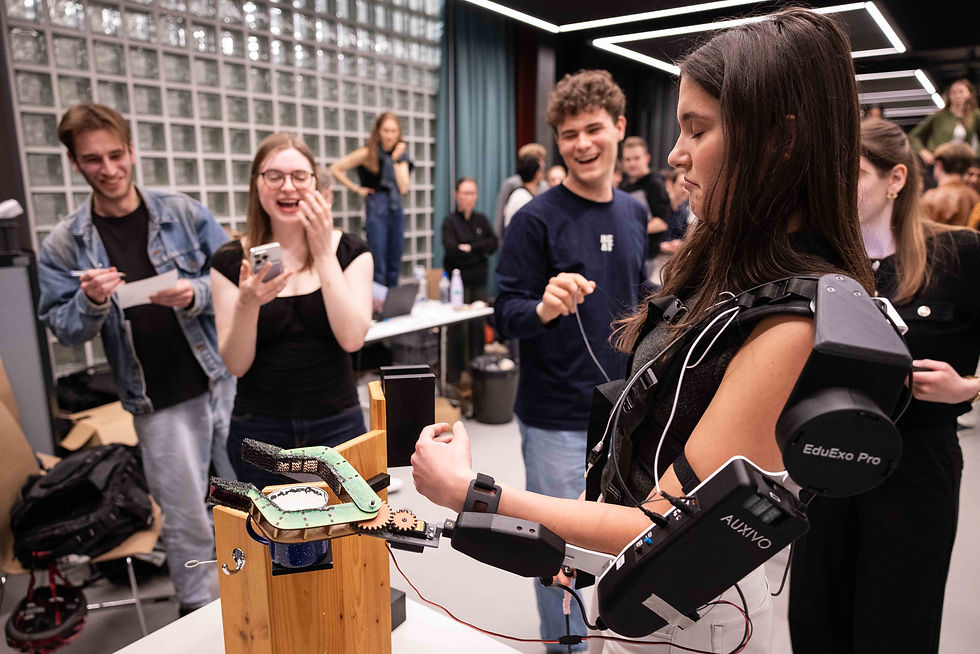
The hackathon concludes with a competition inspired by the CYBATHLON. Teams use their systems to complete tasks involving everyday objects.
Each team operates its EduExo system to pick up objects from a table and place them in designated target locations. All interactions must be performed using the exoskeleton and the custom-built gripper. If an object is dropped, it must be picked up again using the system.
The tasks are arranged in a fixed order. Teams can skip individual tasks, but they are not allowed to return to them later. This requires teams to balance speed and reliability during execution.
Impressions from the competition. The EduExo Pro with the added gripper is used to handle various objects.
In total, teams must handle a range of nine everyday objects with different shapes and difficulty levels. Each object is assigned a specific number of points depending on difficulty:
Ball: 14 points
Plastic cup: 14 points
Pen: 15 points
Metal keyring: 16 points
Plastic ring: 17 points
Metal coffee cup: 18 points
Credit card: 19 points
DVD case: 19 points
USB stick: 20 points
The competition is limited to 3 minutes per team. At the end, all successfully completed tasks are summed up to calculate the total score. The team with the highest number of points wins. If two teams reach the same score, the faster team is ranked higher.
Course Materials
EduExo Pro as a Starting Point
The EduExo Pro serves as a hardware platform and starting point across all course elements.
A total of 24 exoskeletons were used in the course. Each unit provides:
• Upper body and arm interfaces
• Actuation at the elbow joint
• Integrated sensing (force, position, EMG interface)
• A programmable microcontroller for control
Students use the system in every session, allowing them to build familiarity over time and directly connect theoretical concepts to physical behavior. A comprehensive 180-page handbook, covering topics such as hardware, electronics, microcontroller programming, and control systems, provides a solid foundation for the course.
However, the EduExo Pro is not used out of the box. A range of modifications and extensions was introduced to better align the system with the course structure and the needs of medical education at ETH Zurich. Some of these adaptations were prepared in advance by the teaching team, while others were developed as part of the course itself. This approach allows students to actively extend the system through their own implementations, resulting in a more engaging and hands-on learning experience.
Hardware Extension
The most visible modification was the addition of a Gripper at the end of the EduExo Pro's lower arm element. The gripper is actuated by a single servo motor and controlled by the user via EMG signals or additional physical buttons to open and close it. In addition to designing and building the gripper, its integration into the EduExo Pro’s electronics and control structure is a key part of the task.
Technical aspects of the gripper development include:
• CAD-based design of components using Autodesk Fusion 360
• Fabrication using 3D printing and laser cutting
• Integration of a servo motor for actuation
• Mechanical mounting to the EduExo arm
Students typically went through several design iterations, adjusting geometry, force transmission, and mounting.
Gripper development, starting with cardboard mockups to test and visualize concepts, followed by wooden and 3D-printed prototypes.
As creative concept development was a central part of the gripper design project, it led to a wide range of solutions:
Parallel grippers with rigid fingers
Flexible designs using compliant materials
Different gripping geometries optimized for specific objects

Software
The RELab team introduced a new abstraction layer to the entire design, using Jupyter Notebooks. This allows the students to implement the control code in Python instead of the direct Arduino C implementation, which is more aligned with the teaching goals of the medical curriculum at ETH.
The resulting underlying system architecture:
An Arduino layer handles low-level control, actuation, and data collection
A Python layer handles data processing and high-level control
Communication is established via serial communication (USB or Bluetooth)
Jupyter Notebooks were also used to provide the students with various predefined teaching materials over the course, including:
Weekly notebooks: Guided exercises covering all major topics
Troubleshooting notebook: Allows students to independently diagnose issues
Hackathon template: Base structure for student-developed solutions
Gripper Control
One of the key tasks was to implement EMG-based control. During the course and especially in the hackathon, students explored different control strategies.
Typical approaches include:
Threshold-based EMG control: Example: Activation of the biceps above a defined threshold triggers elbow flexion or gripper closing
Proportional EMG control: Mapping EMG amplitude to motor position or velocity
Multi-muscle control setups: Example: biceps activation for closing the gripper, triceps activation for opening

To make it work reliably, students experimented with sensor placement and quickly observed how signal quality and usability change.
Common challenges include:
Signal noise and variability
Muscle fatigue affecting control stability
Difficulty in achieving smooth and intuitive control
These challenges are part of the learning process and are addressed through iterative refinement. As a result, many students became quite creative, resulting, e.g., in the sensors being placed on facial or neck muscles for easier coordination.
Outcome and Observations
After completing the course, students are trained to:
Understand how sensing, control, and mechanics interact in a real hardware system
Implement and evaluate control strategies
Recognize practical challenges in human-machine interaction
Work effectively in interdisciplinary teams
From a teaching perspective, the setup shows that:
Medical students can quickly engage with technical systems when complexity is structured
Hands-on interaction significantly improves understanding of abstract concepts
The EduExo platform is sufficiently robust to support parallel use in large cohorts
Overall, the course was very well received by the students, as reflected in the feedback submitted:
“I really enjoyed designing something myself that ultimately worked.”
“It was really cool to see how, with limited resources and very little prior knowledge, it was possible to build a working robot.”
“I was pleasantly surprised by how much I enjoyed the module. Even though I had relatively little prior knowledge, I was able to write a program within a week that allowed us to control the gripper using EMG. That was a real sense of achievement.”
“Best module of the Bachelor's program!”
The course will continue and is offered once a year to train future doctors, providing them with a solid understanding of the development, opportunities, and challenges of medical device technology.
If you are interested in using the EduExo Pro in your own teaching, please visit our product website for more information or contact us directly with any inquiries.
Pictures used with friendly permission from RELab/ETH Zurich.


